Sunday, March 28, 2010
The global car
According to another little sticker, this one on the driver's window, Gretta is a Mexican Volkswagen, made in VW's Puebla plant. (Here's a list of all of VW's plants.) I've been thinking lately about the globalness of the car, in part because I've been reading Matthew Paterson's great book Automobile Politics: Ecology and Cultural Political Economy (Cambridge University Press, 2007). Paterson sees the car as perhaps the crucial technology for the expansion of modern global capitalism, involved in accelerating both production and consumption and in generating and circulating enormous amounts of industrial wealth. The car industry is often seen as the exemplar of a globalized industry, especially during the 20th century; "Fordist" and "post-Fordist" labels for types of production directly invoke the history of auto manufacturing, and car companies have long been leaders in innovating new forms of global supply and financing. Paterson points out (p. 99) that while much of the actual assembly of cars is still done in the "triad" countries of North America, Japan, and western Europe, other parts of the world are beginning to catch up, particularly in component manufacturing.
Within these vast global flows of cars and car parts, there's a little heritage-oriented trickle created by vintage car collectors and enthusiasts--something that's been on my mind because I got an email yesterday from the Alice's Drive project, letting me know that a New York Times article this week featured a story about how the Alice's Drive team assembled their 1909 Maxwell from scratch. (I wrote about this project in a post earlier this year.)
Much of the hunt for Maxwell parts for the cross-country reenactment of Alice Ramsey's 1909 trip took place on the U.S. swap meet circuit, but the Internet was of course a key tool for the team as well. The Times article quotes Richard Anderson, who assembled the car: “My wife and I were on our wedding anniversary in Italy, and we stopped at an Internet cafe to get a cup of coffee and check our e-mails. And there’s an e-mail there from a Maxwell guy who lives in Australia. He said you ought to check out number such and such on eBay, I think these are the levers you need.”
Ordering hundred-year-old American-made levers from Italy on an email tip from an Australian, like driving a Mexican-made German car in New England, underscores the globalness of car-making. But the Maxwell story also makes me realize that automobility's past is still circulating out there, too, in tangible ways that newer technologies make increasingly accessible. This is a pleasing thought, given my sense that we need to see and recognize automobility’s histories (those dim days before the advent of the Check Engine light) if we’re going to remake or unmake it. Perhaps cars are really neither created nor destroyed, but are all just out there somewhere circulating in global flows that we may be able to tap into if we're tenacious enough.
Tuesday, June 9, 2009
Pilgrims and Progress (on Petroleum)

A dark and rainy day it is for the launch of a cross-country centennial reenactment of Alice Ramsey's 41-day drive across the U.S. in a 1909 Maxwell touring car. Ramsey was a 22-year-old Vassar graduate and avocational car racer who undertook the 3,800 mile trip in part to prove that a woman was capable of matching the feat already accomplished by numerous men in the previous six years and in part as a publicity campaign for the Maxwell car company (which was subsumed in the Chrysler company in the 1920s). A real-life version of the plucky girl motorists whose adventures formed the basis of a sub-genre of kidlit in the early 20th century, Ramsey lived until 1983, and published her own narrative about her trip, called "Veil, Duster, and Tire Iron," in 1961.

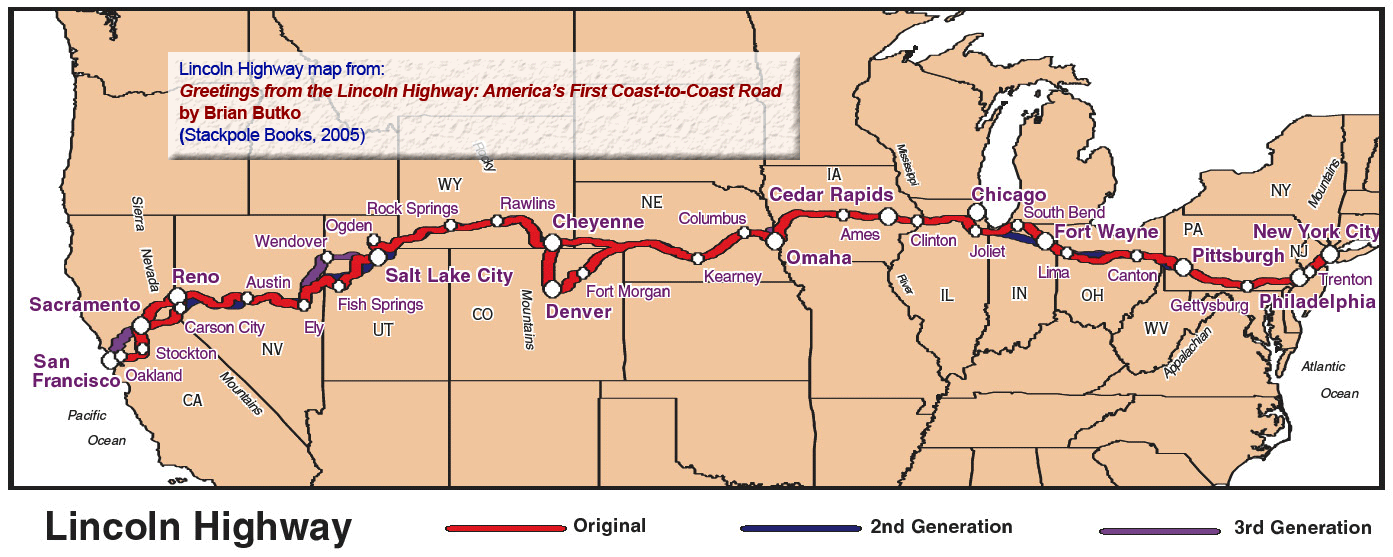
The centennial project was initiated by an antique car buff from Washington State, Dr. Richard Anderson, who recruited his daughter Emily to take the role of Alice Ramsey in the cross-country drive. The route will largely follow the 1909 itinerary, with due alterations for changes in the road system and without the hazards of the unpaved roads of early 20th century America (as seen above). Part of this route follows what would become, in 1913, the Lincoln Highway, a kind of prototype for the later Interstate system. (Click here for the original Lincoln Highway route. The Lincoln Highway Association's own annual conference in South Bend, Indiana will be a stop on the Ramsey/Anderson trip.)
All of this gives me lots of food for thought, too much for a single blog post. As my colleague David Glassberg put it yesterday in discussion about automobility and heritage at the Mass. History Conference, "the auto is deeply woven into the DNA of historic sites" because road-building, automobile-promotion, and way-marking projects have so often overlapped with each other, right from the earliest days of the car. It's a process that continues in the heritage area movement, which ties whole regions together thematically and creates auto, bike, boat, and pedestrian routes through them. This is a history I hope to be exploring more deeply as I get further into my cars and heritage research.
On this rainy Tuesday morning, though, what I'm mostly thinking about is how the symbolic resonance of the journey reflects various human conceptions of progress and achievement, whether that means escaping the cycle of reincarnation, visiting the axis mundi, becoming the first woman to cross a continent by car, or overcoming cancer. This notion of moving toward something better or more transcendent is of course the basis for pilgrimage, which has a very long history. Theoretically, the liminal qualities of movement and travel always open up some space for reflection and some potential for transformation. It's surely no coincidence that Emily Anderson, who is taking the role of Alice Ramsey in the centennial journey, is a professional event manager for a company that designs fundraising walks and other events for non-profit organizations (for example, three-day breast cancer walks).
So how do we understand a pilgrimage in a petroleum-powered car at a time when you can make a case that the resonance of both cars and petroleum is tinged with as much gloom as hope? There are lots of indications that the Ramsey reenactment crew is thinking about transformation on both personal and social levels (Emily Anderson chose Women for Women International as the beneficiary of any proceeds from the drive, making the connection between the mobility and opportunities open to some women but closed to others). But there's no sign that the project is encouraging anyone to think about transforming our automobile or petroleum use, which makes me suspect that this may be another of those efforts, like the Sharon Welcome Center in Vermont, that promotes positive social change in one direction while masking its own close ties to a culture of automobility that continues to have less-than-positive social and environmental implications. This seems to be another way of "progressing" (literally and symbolically) without necessarily questioning the costs of the "progress" we've already made.
I may be wrong about the potential for reflection on all of this in the Ramsey re-creation, and maybe it's just the gloom of the dark morning that's getting to me! Surprising things can always happen on the road. As a reality check, though, I just want to note another news story today: a long-awaited resolution in a legal case against Shell Oil for its complicity in the 1995 execution of Ogoni activist Ken Saro-Wiwa and eight others who were protesting the environmental degradation caused by the operation of foreign oil companies in the Niger delta. Shell agreed to a $15.5 million settlement, a mere drop of its overall profits but an important precedent for human rights groups looking for ways to hold multinational corporations accountable. $5 million of the settlement will be used to set up an educational foundation in the delta region. In the Gokana language spoken by the Ogoni, the name of the trust, Kiisi, means "progress."